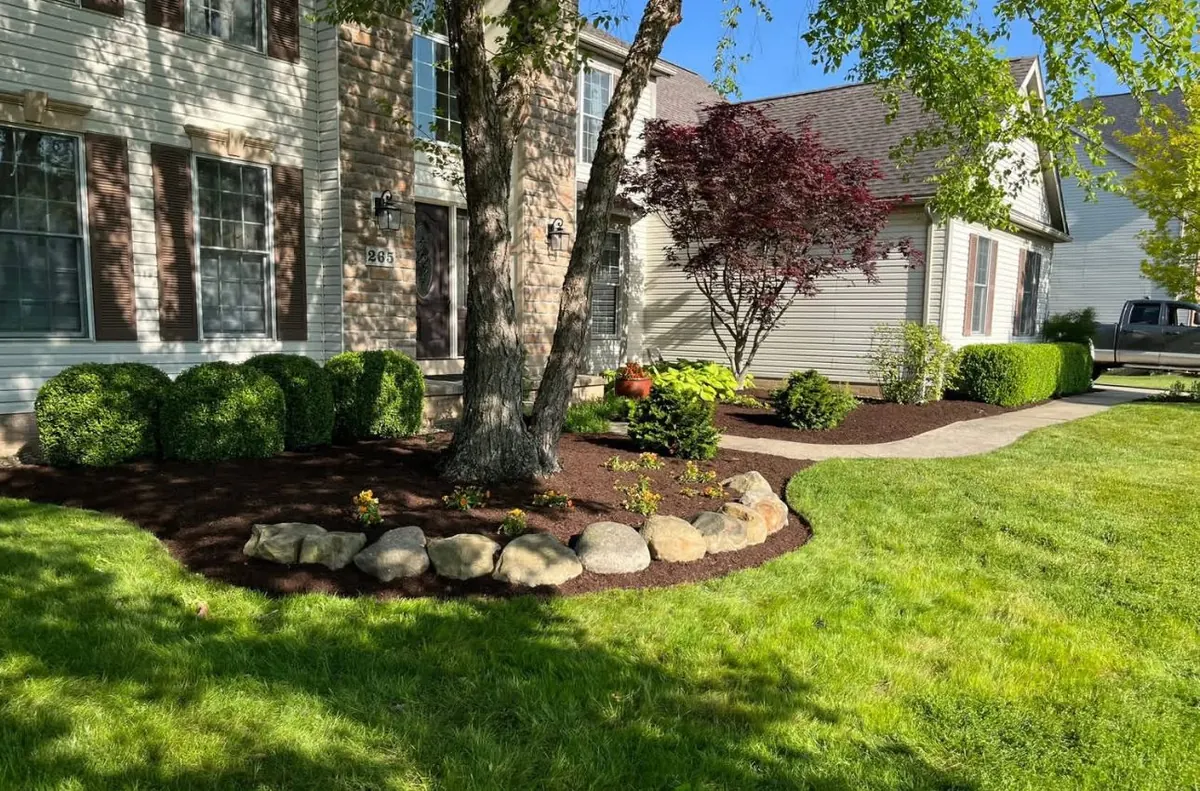
Every April we get the same call. Somebody in Aurora or Bainbridge is staring at their landscape beds, wondering how many yards of mulch to order and whether they're going to look like an idiot when the dump truck shows up with too much or — worse — not enough.
Here's the actual math, the depth we recommend for Northeast Ohio properties, what colors actually work with our heavy clay soils, and when in the season to put it down.
The simple formula: how to calculate cubic yards of mulch
Mulch is sold by the cubic yard. The math is straightforward once you know the formula:
That 324 is the magic number — it converts square feet times inches into cubic yards. Memorize it and you'll never miscalculate a bed again.
A worked example
Let's say you've got a landscape bed across the front of your house. It's roughly 30 feet long and 6 feet deep. You want a fresh 3-inch layer of mulch.
Round up to 2 yards and you're set. For most suburban homes in Aurora or Chagrin Falls with foundation beds across the front and a few accent beds around trees, total mulch needs typically land between 4 and 10 cubic yards.
Quick-reference mulch quantities
If you don't feel like measuring, here's a rough guide based on what we typically see on suburban properties:
- 1 cubic yard covers about 100 sq ft at 3 inches deep — enough for a small bed or two tree rings
- 3 cubic yards covers around 300 sq ft — typical for a foundation bed plus one or two accents
- 5 cubic yards handles a fully landscaped suburban front yard
- 10 cubic yards is normal for a larger Chagrin Valley property with extensive beds
What depth should mulch actually be?
This is where most homeowners go wrong. They either spread it too thin (it disappears by August) or pile it on like a volcano around the tree trunks (which can kill the tree).
The right answer for Northeast Ohio:
2 to 3 inches in established beds
This is the sweet spot. Thick enough to suppress weeds and hold moisture, thin enough to let water and air reach the soil. If you've already got 2 inches of last year's mulch still in place and it's broken down nicely, you only need 1 inch of fresh mulch on top to refresh the look. You're not starting over every year — you're topping up.
1 inch on top of existing mulch
Most properties don't need a fresh 3-inch layer every spring. If your beds still have a healthy base from last year, a thin topcoat is plenty. Piling fresh mulch on top of years of accumulation is how you end up with 6 inches of mulch suffocating your shrubs.
Never against tree trunks
The dreaded "mulch volcano" you see at gas stations and shopping centers — mulch piled high and tight against tree bark — is a death sentence for trees. Keep mulch a good 2 to 3 inches back from the trunk. The flare of the tree where the trunk meets the roots needs to breathe.
What color mulch works best with Northeast Ohio clay soils?
This part doesn't get talked about enough. We have heavy, orange-tinted clay soils across most of Geauga and Portage counties. That undertone matters more than people realize when you're picking mulch color.
Dark brown — our default recommendation
A natural dark brown (sometimes sold as "premium brown" or "dark hardwood") is the safest bet for almost every home in our service area. It reads as rich and intentional without fighting your house color, and it doesn't clash with the warm undertones of our soil where it shows at the edges.
Black mulch — proceed with caution
Black mulch looks sharp the first month. The problem is it fades to a flat, washed-out gray within one Northeast Ohio summer of sun and rain. It also retains heat aggressively, which stresses shallow-rooted plants during our August dry stretches. On clay soil it can look stark and oddly contrasty. We use it occasionally for modern homes where the contrast is intentional — but it's not our default.
Red and "cedar" mulch — almost never
Red-dyed mulch tends to look artificial against the natural greens and earthy tones of mature Chagrin Valley properties. It's the right call for almost nobody in Aurora or South Russell. Most of the time when a homeowner asks for red, what they actually wanted was a warmer brown.
Natural hardwood (undyed)
Best for woodland-style properties — homes with mature trees, naturalistic plantings, native gardens. The color shifts toward gray within a few months but it ages beautifully and feeds the soil better than dyed alternatives.
When should you mulch in Northeast Ohio?
Timing matters. Get it down too early and you trap cold air over plant crowns just when they're trying to emerge. Wait too long and weeds beat you to it.
The Aurora-area window: mid-April to late May
Once the soil has warmed and your perennials are visibly growing, you're clear to mulch. For most of our Bainbridge and Auburn clients, this lines up with the last week of April through Mother's Day. Get it down after spring cleanup, before the early summer weeds explode.
Fall mulch — sometimes worth it
A light layer of mulch in late October helps insulate roots through the freeze-thaw cycles that beat up clay soil all winter. We don't always recommend it, but for newer plantings, marginal-hardy plants, and shrubs in exposed spots, a fall touch-up is good insurance.
"More mulch isn't better mulch. The right depth, the right color, refreshed at the right time — that's what makes a property look intentional instead of cluttered."
Bagged vs bulk: which makes sense?
Bagged mulch (the 2 cubic foot bags at the hardware store) is fine for small jobs — one or two beds, maybe 6 to 8 bags. Past that, the math doesn't work. It takes 13.5 bags to equal one cubic yard, and bagged mulch usually costs 2 to 3 times more per yard than bulk.
For anything over 3 yards, get bulk delivered. Most local suppliers in Mantua, Auburn, and Bainbridge will deliver to Aurora and the Chagrin Valley for a flat fee. Or hire us to install it — we factor mulch, delivery, edging, and labor into a single quote so you're not playing project manager.
What's actually included in a professional mulch install
When we quote mulch as part of landscaping or seasonal cleanups and pruning, here's what's happening:
- Bed edge cut fresh — a crisp natural edge between bed and lawn
- Bed weeded thoroughly before any mulch goes down
- Existing mulch evaluated — refreshed if it's compacted, topped if it's healthy
- Mulch installed at the right depth, kept clear of trunks and crowns
- Hardscape blown clean afterward — no stray mulch on the walkways
A mulch install done right takes the property from "fine" to "intentional" in a few hours. Done wrong, it actively damages plants and looks worse than no mulch at all.
Skip the math. Get a quote.
We measure, calculate, and install mulch for properties across Aurora, Chagrin Falls, Bainbridge, South Russell, and Auburn. Free estimate, no pressure.
Get My Mulch Quote