Spring Lawn Wake-Up Schedule for Northeast Ohio (Week-by-Week)
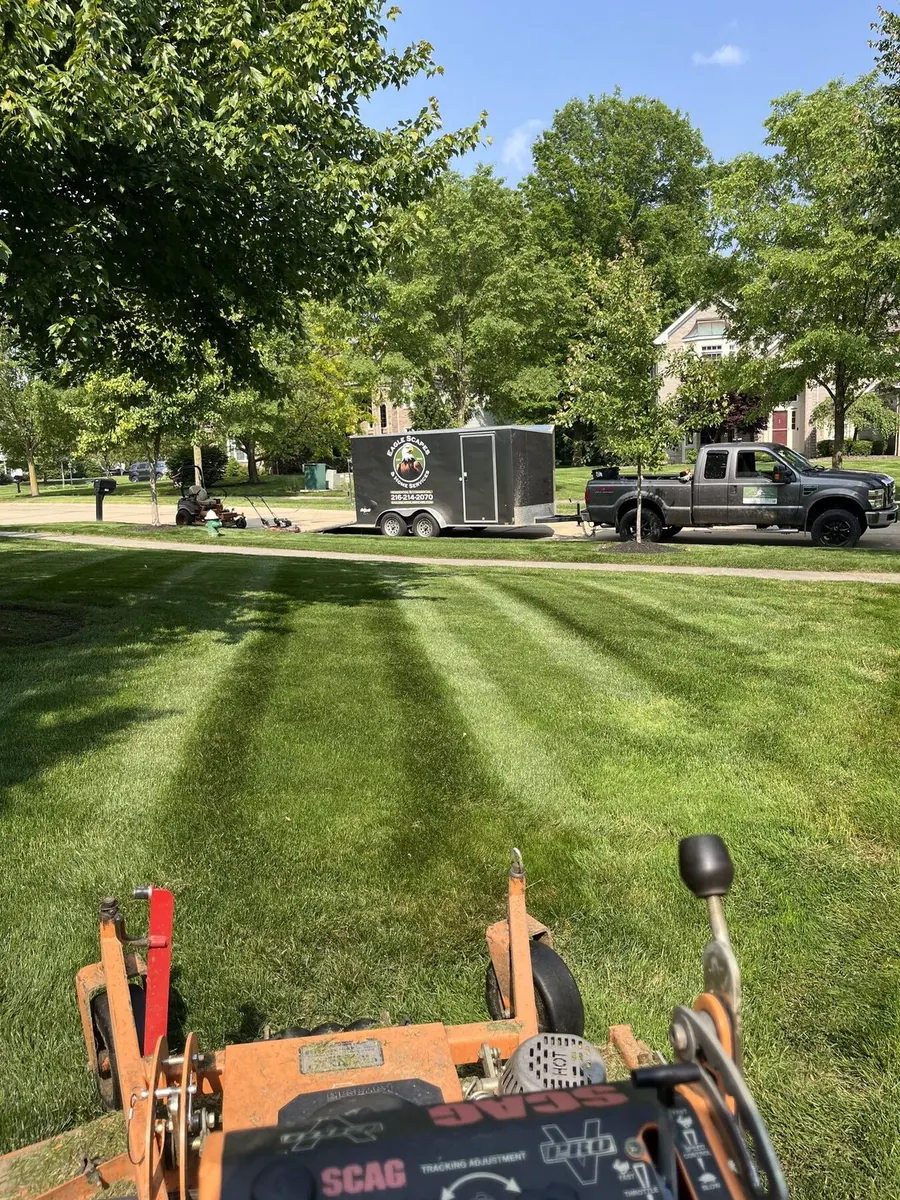
A real spring lawn care schedule Ohio homeowners can follow starts in mid-March with a walk-through, not a mow. Week-by-week through Memorial Day in Zone 6a Northeast Ohio: walk and clear debris (mid-March), light rake and tune equipment (late March), first mow at 3-3.5" when soil hits 45-50°F (early April), crabgrass pre-emergent at forsythia bloom (mid-April), weekly mowing on the one-third rule (late April), spot-treat weeds and a light feed (early May), and monitor for grubs and disease through late May.
Every March I get the same texts from clients in Aurora, Chagrin Falls, and Bainbridge — usually attached to a photo of a brown, matted-down lawn. "When are you starting?" The honest answer is that a spring lawn care schedule Ohio yards actually respond to is run by soil temperature and ground moisture, not the date on the calendar. Northeast Ohio sits in USDA Zone 6a, which means the ground holds winter long after the air feels like spring. Below is the week-by-week plan I run on my own route, what to look at on your property before you do anything, and where homeowners cost themselves a full season of healthy turf by jumping the gun.
When does spring lawn care actually start in Northeast Ohio?
Real spring lawn care in Zone 6a Northeast Ohio starts in mid-March with a walk-through, not a mow. You pick up sticks and storm debris, scan for snow mold, and let the soil dry. Active work — dethatching, the first cut, pre-emergent — does not begin until late March through mid-April depending on soil temperature, not the calendar date.
The first week of usable spring work is almost always the second or third week of March around Aurora. By then most of the snow is off, but the ground is still cold and saturated. What you are doing that week is reconnaissance. Walk the entire lawn in a slow grid pattern. Pick up the sticks and branches the winter dropped, especially anything bigger than pencil-width that will jam a mower deck. Note where the turf looks gray, matted, or has whitish rings — that is snow mold, and it is normal in Northeast Ohio after a long snowpack. Most snow mold lifts on its own as soon as the turf dries and gets air; you just need to lightly rake the worst spots to break up the matting.
This is also when to look at hardscapes and beds. Frost heave around walkways, settled mulch, salt damage along driveways, gaps in bed edges — flag all of it now so you can build a spring punch list. If you want a deeper walkthrough of what a real seasonal reset includes, our spring cleanup in Northeast Ohio post covers timing and scope. The key principle for week one: look, do not mow. Mowing dormant grass on cold saturated ground sets the season back two to three weeks.
What's the week-by-week schedule from thaw to Memorial Day?
The week-by-week sequence below tracks how I time work across my Aurora and Geauga County route every spring. Dates shift a week or two with the weather, but the order never changes — debris first, soil second, equipment third, first mow, pre-emergent, regular mowing, then targeted treatments. Follow it and your lawn will be ahead of 80% of the neighborhood by Memorial Day.
| Week | Approx. Date | Task | Trigger / Condition |
|---|---|---|---|
| Week 1 | Mid-March | Walk lawn, pick up sticks & debris, check for snow mold | Snow off, ground still wet — do NOT mow yet |
| Week 2-3 | Late March | Light rake snow mold, dethatch if thatch >0.5", sharpen mower blade, inspect equipment | Surface dry enough to walk without leaving prints |
| Week 4 | Early April | First mow when grass hits 3-3.5", bag clippings on first cut | Soil temp climbing 45-50°F at 2" depth |
| Week 5-6 | Mid-April | Apply crabgrass pre-emergent | Forsythia in full bloom, soil temp 50-55°F |
| Week 7-8 | Late April | Start regular weekly mowing, deck set to 3-3.5", follow one-third rule | Active growth visible week to week |
| Week 9-10 | Early May | Spot-treat broadleaf weeds (dandelions, clover), light spring fertilizer | Daytime temps consistently 60°F+ |
| Week 11+ | Mid-May | Second pre-emergent application if doing a split, check irrigation | ~8-10 weeks after first pre-emergent |
| Week 13+ | Late May | Monitor for grub damage and early lawn diseases | Soil warm, turf actively pushing |
A few notes on the sequence. The late-March equipment pass matters more than people think — a dull mower blade tears the grass instead of cutting it, and torn tips turn brown within 48 hours and invite disease. Sharpen the blade, check the air filter, change the oil if you skipped it in fall, and run a tank of fresh fuel through. For the early-April first mow, bag the clippings even if you normally mulch — that first cut picks up a lot of dead winter material you do not want sitting on the crown. After that, mulching is fine.
The mid-April crabgrass pre-emergent window is the single most time-sensitive item on the list. Miss it by a week and you fight crabgrass all summer. We cover the exact application logic in our crabgrass preventer timing guide for Northeast Ohio, but the forsythia-bloom rule is the easiest visual cue around Aurora and Chagrin Falls.

What's the biggest spring lawn mistake homeowners make?
Mowing too early on saturated ground. Northeast Ohio clay soils hold winter moisture for weeks after the surface looks dry. Running a mower across soggy turf creates ruts, compacts the root zone, and damages crowns that have not fully woken up. The footprint test — if you leave a print walking the lawn, it is not ready — is the single best gauge.
I see the early-mow mistake on at least a third of new client properties every April. The pattern is always the same: 65-degree Saturday in late March, homeowner cannot stand looking at the rough lawn one more day, fires up the mower, and runs across ground that is still 40°F two inches down. The mower wheels press the wet clay into a compacted lid that water cannot move through, the crowns of the grass plants get sheared off before they have woken up, and the lawn limps along for six to eight weeks looking thin and pale while the neighbors who waited are dark green and dense.
Second biggest mistake: overfertilizing in spring. Cool-season grasses do their real root-building work in fall, not spring. Hitting them with a heavy spring nitrogen feed pushes top growth at the expense of roots, makes the lawn drought-vulnerable in July, and feeds disease pressure during the wet May weeks. A light application in early May is plenty. Save the heavy nitrogen for the September-October window when it actually banks the lawn for the next year.
Third: skipping the equipment tune-up. A dull blade, low tire pressure on one side of the mower, or a clogged air filter will quietly trash a lawn over six weeks of cuts. Twenty minutes in the garage in late March pays back the rest of the season.
How do you know when soil is ready for the first mow?
Wait until soil temperature is climbing through 45-50°F at a 2-inch depth, which usually happens in early April in Aurora and the Chagrin Valley. Below 45°F the grass is still dormant and mowing does nothing useful. A cheap probe thermometer from a hardware store reads soil temp in 30 seconds and takes the guesswork out of the call.
Three signals I stack before I run the first cut on a client property. One: soil temp. I carry a $12 probe thermometer in the truck and stick it 2 inches down in three or four spots — front yard south side, back yard north side, anywhere shaded. If the average is climbing through the high 40s, the grass is waking up and a cut is productive. Two: the footprint test. Walk diagonally across the wettest section of the lawn. If your boots leave clear prints, the soil is still too saturated to support equipment. Three: grass height. Cool-season turf in Northeast Ohio is ready for its first cut when the blades have reached about 3 to 3.5 inches and are standing up rather than laying flat. If it is still flat and brown, it is not photosynthesizing yet and a cut just damages the crown.
Set the deck to 3 to 3.5 inches for that first cut. Scalping the lawn short — which a lot of homeowners do thinking it will green things up faster — exposes the soil to weed seeds and dries the root zone right when the plant is trying to push new growth. Bag the clippings the first time only, then go back to mulching. If you want help locking in a weekly mow schedule from the right starting point through October, our property maintenance program handles all of it on a flat seasonal rate.
When should you call a pro for spring lawn care?
Call when the schedule above feels like a part-time job, when you are uncertain about pre-emergent timing or product choice, or when a previous spring left you with thin turf, crabgrass breakthrough, or compaction issues you do not want to repeat. An locally owned outfit running the same route every week catches problems earlier than a homeowner who only looks at the lawn once a weekend.
The honest line I give people: if you enjoy the work and have time on weekends, the schedule above is completely doable yourself. The pre-emergent and fertilizer products at a good local nursery are the same families a pro applies. Where homeowners get into trouble is the timing windows — miss the forsythia bloom by ten days and you are fighting crabgrass into August. Apply fertilizer two weeks too early and you stress the lawn before summer heat. A pro is mostly paying you back in timing precision and equipment leverage, not in some secret product.
The other case for a pro is when the lawn has been neglected for a season or two and needs a reset — heavy thatch, ruts from prior bad mows, dead patches that need overseeding, or beds that have been overrun with weeds and last year's leaves. That kind of work is faster and cheaper done as a proper spring cleanup and pruning visit than spread across six weekends. If the property also needs bed regrades, new edging, or refreshed plantings, our landscaping services rolls that into the same visit. And once the spring sequence is done, the fall version matters just as much — our fall leaf cleanup guide for Aurora picks up where this schedule leaves off.
Want this spring schedule run for you?
Locally owned weekly mowing, pre-emergent timing, and full spring resets across Aurora, Chagrin Falls, Bainbridge, South Russell, and Auburn. Routes fill by mid-April — get on the list now.
Call (216) 516-7730 Request a QuoteFrequently Asked Questions
When does spring lawn care actually start in Northeast Ohio?
Real spring lawn care in Zone 6a Northeast Ohio starts in mid-March with a walk-through, not a mow. You pick up sticks and storm debris, scan for snow mold, and let the soil dry. Active work — dethatching, the first cut, pre-emergent — does not begin until late March through mid-April depending on soil temperature, not the calendar date.
What soil temperature do I need before the first mow?
Wait until soil temperature is climbing through 45-50°F at a 2-inch depth, which usually happens in early April in Aurora and the Chagrin Valley. Below 45°F the grass is still dormant and mowing does nothing useful. A cheap probe thermometer from a hardware store reads soil temp in 30 seconds and takes the guesswork out of the call.
When should I put down crabgrass pre-emergent in Northeast Ohio?
Apply crabgrass pre-emergent when forsythia is in full bloom, typically mid-April in Aurora, Chagrin Falls, and Bainbridge, when soil temperature reliably hits 50-55°F. That is the window before crabgrass seeds germinate. Apply too early and the chemical breaks down before the seeds wake up; too late and the seeds are already growing.
What is the biggest spring lawn mistake homeowners make?
Mowing too early on saturated ground. Northeast Ohio clay soils hold winter moisture for weeks after the surface looks dry. Running a mower across soggy turf creates ruts, compacts the root zone, and damages crowns that have not fully woken up. The footprint test — if you leave a print walking the lawn, it is not ready — is the single best gauge.
Do I really need to dethatch every spring?
No. Only dethatch if the thatch layer is over half an inch. Most Aurora and Bainbridge lawns have less than that and aggressive dethatching does more harm than good by tearing up healthy crowns. Pull back the grass with your fingers and measure. If the brown matted layer between soil and green blade is under half an inch, skip it.
How often should I mow in spring once growth starts?
Once a week starting in late April, following the one-third rule — never remove more than one-third of the blade height in a single cut. Set the deck to 3-3.5 inches for cool-season grasses. In rapid May growth you may need to mow twice a week briefly. Keep blades sharp; dull blades shred tips and brown the lawn within 48 hours.
Should I fertilize my lawn in early spring?
Use a light hand in spring. Cool-season lawns in Northeast Ohio do most of their root work in fall, so heavy spring fertilizer pushes top growth at the expense of roots and invites disease. A light early-May feeding tied to your pre-emergent is plenty. Save the heavy nitrogen for September and October when it actually does the lawn the most good.